When the Waistcoat Became Optional
When the waistcoat became optional, men’s suits gained a layer of choice. See how changing British dress customs made the three-piece suit one option among several.
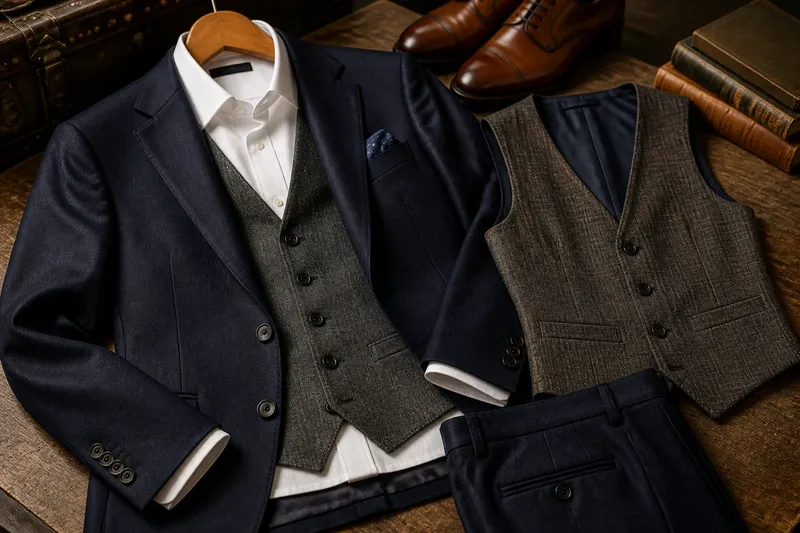
The waistcoat became optional gradually, and not at the same pace in every British workplace or social setting. In the history of the suit, its changing role is visible in ordinary choices: a jacket worn over a shirt, a two-piece suit at work, or a waistcoat kept for more formal occasions.
Rather than disappearing, the waistcoat shifted from an expected component in some forms of dress to a layer people could choose. It could complete a formal outline, cover the shirtfront and add warmth; changing routines gave wearers more reasons to leave it off and new ways to use it deliberately.
The three-piece suit offered a familiar formal outline
In British menswear, the three-piece suit—jacket, waistcoat and trousers—was a familiar formal arrangement, particularly in settings where coordinated tailoring was expected. It was never the only way men dressed, and expectations varied by period, occupation, occasion and means.
The waistcoat filled the visible space between shirt and jacket, giving the torso a continuous, finished appearance when the coat was open or removed. It also added a layer over the shirt, useful in cool conditions or when someone was expected to remain suitably dressed without a jacket.
A matching waistcoat reinforced the suit’s unity; a contrasting one introduced a deliberate accent. The three-piece form supplied a recognisable option, not a rule that every man dressed identically.
Everyday routines made the waistcoat easier to leave off
As dress expectations loosened in many British settings, a jacket and trousers could stand on their own. The two-piece suit offered a simpler arrangement for situations where an extra layer’s warmth or formality was unnecessary; it did not make tailored clothing itself irrelevant.
Practical preferences also played a part. Someone travelling between an office, public transport and heated rooms might find an additional layer uncomfortable, while a jacket over a shirt could still look smart. More relaxed leisure dress made it easier to treat suit components as choices rather than as an inseparable set.
The change overlapped rather than arriving as a clean handover. A waistcoat might remain customary for a ceremony, a particular profession or a social occasion even as colleagues wore two-piece suits during the working week. One person could own both and choose according to context.
Optionality gave the waistcoat a more deliberate meaning
Once a waistcoat was no longer expected in every setting, wearing one could signal ceremony, tradition or a carefully composed style. Leaving it off could suggest ease without making the rest of the outfit careless; the meaning depended on the clothes and occasion around it.
A waistcoat also offered a way to add interest without replacing a whole suit. A subtle pattern, a different cloth or a distinct texture could create contrast beneath a plain jacket. A waistcoat in a similar shade and material, by comparison, kept the three-piece silhouette cohesive.
Say a man has a navy two-piece suit for a family gathering, and the invitation suggests a more formal atmosphere than an ordinary lunch. He adds a grey waistcoat, keeps his shirt and tie restrained, and checks that the jacket still sits comfortably over the extra layer. The result is a more ceremonious outline while the original jacket and trousers remain in use; for a relaxed afternoon event, he might leave the waistcoat off instead.
Photographs reveal choices, not a universal timetable
Old photographs and surviving garments can make changing dress customs easier to read, but one missing layer cannot establish a general rule. The jacket’s cut, the shirt and tie, the setting and the wearer’s likely purpose all help explain whether a waistcoat was expected, chosen or unsuitable.
- Check the occasion shown. If the image records a ceremony or formal portrait, a complete suit may reflect that setting; if it shows work or leisure, compare it with other evidence before treating the outfit as typical.
- Check whether the jacket is present. If the waistcoat is worn alone, it may be carrying more of the outfit’s structure; if the jacket is on, judge the waistcoat as one layer within the full suit.
- Check whether the pieces match. If the waistcoat matches the jacket and trousers, read it as a coordinated suit; if it contrasts, consider whether it was chosen as an accent rather than as a standard component.
- Check how much shirtfront shows. If the jacket is open and the waistcoat covers much of the shirt, the layer helps shape the torso; if more shirt is visible, consider the jacket’s cut and styling before drawing a conclusion.
- Check the clothing’s condition and context. If a garment is incomplete or the image is unclear, avoid treating the missing waistcoat as evidence of a broad change; seek a clearer image or compare another garment from a similar setting.
Why did men stop wearing waistcoats every day?
Did the two-piece suit replace the three-piece suit?
It became an alternative rather than a complete replacement. Men could wear a two-piece for routine occasions and keep a three-piece for settings where an extra layer felt appropriate.
Was a waistcoat mainly for warmth?
Warmth was one use, but the waistcoat also shaped the suit’s appearance and helped maintain a dressed look when a jacket was removed. Its importance varied with climate, indoor conditions and social expectations.
Could a waistcoat be worn without a matching suit?
Yes. A contrasting waistcoat could form part of an outfit, though its visual weight and formality depended on the cloth, fit and surrounding clothes.
The waistcoat remains a deliberate choice
The waistcoat can make a familiar suit feel more formal, more traditional or more individual, depending on how it is styled. Its absence is now ordinary in many settings, but the garment remains available when its extra layer and finished outline suit the occasion.
To understand when the waistcoat became optional, look beyond whether it appears in one outfit. The setting, the other garments and the wearer’s purpose help explain whether it was a convention, a practical layer or a personal choice.