The Hidden Work of a Jacket Lining
A jacket lining affects its finish, movement and comfort. Learn how to inspect seams, vents and ease so you can judge what is happening inside.
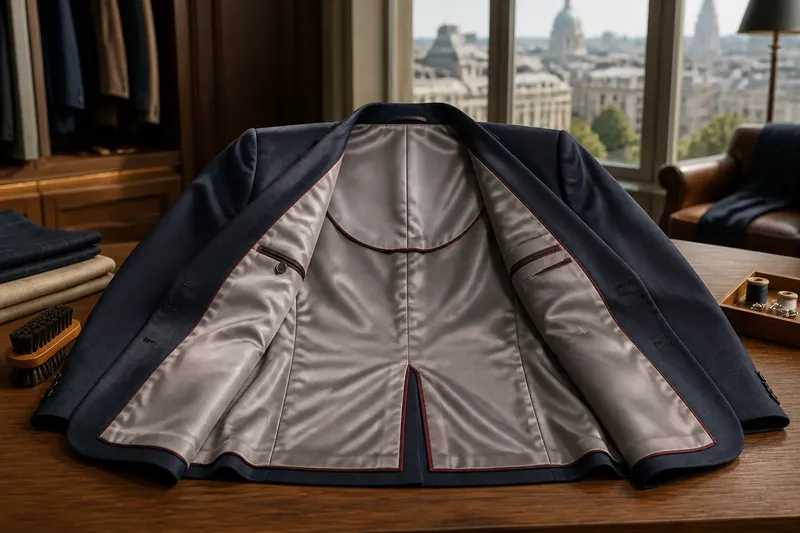
A jacket lining can make the inside feel orderly, help the outer fabric move over a shirt and affect how freely you can reach or bend. To inspect a jacket lining, start at the opening, then follow its seams and move the garment gently; each area tells you something different about construction and fit.
Start by opening the jacket without pulling it
Set the jacket on a clean, flat surface, or hold it open in good light. Undo the front buttons and part the fronts with your hands rather than tugging at the lining. Look at the whole interior before focusing on details: note whether the lining covers most of the inside, where it stops, and how it meets the hem, sleeves and pockets.
A full lining generally covers the body and sleeves, while a partial lining leaves some of the interior outer fabric visible. Neither arrangement is automatically better. A partial lining may leave more of the shell visible and reduce the amount of fabric inside; a full lining creates a more continuous interior surface. Consider what you want from the jacket and how it feels in use, rather than treating one layout as a quality ranking.
Look for an opening or small gap at the lower back, often called a lining vent or hem opening. It can provide access to the inside of the jacket and allow some movement between the lining and shell. Its presence and exact position vary, so record what you see rather than assuming every jacket should have the same opening.
Trace the lining from the neckline to the hem
Follow the lining with your eyes from the back neck downwards. Check whether the seams lie smoothly and whether the fabric is caught evenly where the lining joins the facing, the inner finished edge of the jacket front. At the hem, notice whether the lining has room to hang rather than being pulled taut against the outer shell.
Inspect the shoulder area and armholes next. These are busy junctions: the sleeve lining, body lining and outer fabric meet there, and a bulky or twisted join can feel noticeable when you put the jacket on. You do not need to identify every seam type. Simply note whether the inside looks settled, with no obvious twists, loose threads or puckered patches.
Turn the sleeve opening back only if it moves easily. The lining should sit inside the sleeve without bunching into a thick roll. If the sleeve has a cuff opening or button detail, look at how the lining finishes nearby; decorative buttons do not necessarily indicate that the sleeve opens, so judge the lining on its own construction.
Pay attention to pocket bags, too. These are the fabric pouches behind the pockets, and they may be attached to the lining or to a seam in the jacket. Check that they sit flat when empty and do not pull the lining into a sharp diagonal. If a pocket is carrying something, remove it before assessing the interior, since the weight can disguise how the lining hangs.
Check where the lining allows movement
With the jacket on, leave it unbuttoned and move as you would during an ordinary day. Reach forward, bend your elbows and sit down. Notice whether the lining slides against your shirt, catches at the back, or draws the jacket sharply across the shoulders. These observations help separate a lining issue from a general fit issue.
Then close the jacket if that is how you expect to wear it. Raise your arms slightly and bring them forward. The shell and lining should move together without the interior dragging the hem upwards or pinning your shoulders. A lining that feels tight may be caught, twisted or simply have little ease; the sensation alone does not establish which cause applies.
Ease is the small amount of extra room that lets one layer move without straining against another. A lining needs enough length and width to follow the jacket through ordinary movement. If it is pulled straight across the back or lifted away from the hem whenever you move, look for a visible sign of tension rather than assuming the outer jacket itself is too small.
Imagine you are considering a navy jacket that feels comfortable while standing but rides up when you reach for a shelf. You notice the lining is taut across the upper back and its hem lifts with the shell. Try the same movement with the jacket unbuttoned, then with your arms relaxed; if the pull remains localised to the lining, you have a specific point to ask a tailor about, rather than a vague complaint that the jacket feels wrong.
Compare the lining with the outer fabric
Look at the lining’s surface and how it behaves against the garment. A smooth lining may help the jacket pass over a shirt or knit without catching, while a more textured surface can feel different against the layers underneath. Touch the fabric lightly; there is no need to infer durability or comfort from shine alone.
Notice whether the lining feels cool, crisp, soft or slippery to your hand, but treat that as a first impression rather than a prediction of how it will feel after hours of wear. The shirt or jumper you wear beneath it changes the sensation. If you are shopping, wear a familiar layer or try the jacket over the kind of clothes you expect to pair with it.
Check the colour and pattern in relation to the jacket, too. A lining can be discreet or deliberately visible when the jacket opens. That is a design choice, not a measure of workmanship. More useful signs are whether the pattern sits neatly at seams and whether the fabric lies without twisting around the body.
Read the details at seams, vents and pockets
Examine a few points where separate pieces meet. At the front, the lining should meet the facing cleanly; at the back, any pleat or fold should lie as intended rather than being trapped under a seam. Around vents, check that the lining does not obviously bridge an opening in a way that pulls when the jacket moves.
Look inside the pockets without forcing them open. Their bags should be secured so they do not hang loose or turn inside out as you handle the jacket. If the pocket opening is lined with a different fabric, compare how it is attached and whether the edge feels tidy. Small variations can be deliberate, but a seam that is visibly coming apart deserves a closer look.
Use a practical inspection sequence:
- At the back neck: Check that the lining meets the inner edge evenly. Decide whether any unevenness looks like a minor finish variation or a loose join worth asking about.
- Across the shoulders: Look for twisting or taut fabric. If it pulls when worn, try the jacket over your usual layer before judging the fit.
- At each armhole: Check for bunching and feel whether the join rubs during arm movement. Decide whether the sensation is acceptable for the way you plan to wear it.
- Along the front edges: See whether lining and facing lie flat together. If they roll or ripple, inspect both sides before deciding whether it is a construction concern.
- At the lower hem and vents: Look for a relaxed hang and clear movement. Decide whether the lining restricts the way you sit or walk.
- Inside each pocket: Check that the pocket bags lie flat and the seams appear secure. Remove anything stored there before assessing the drape.
Use the list as a way to notice and compare, not as a demand for identical interiors. The appropriate finish depends on the jacket’s design and intended use. If a defect, alteration or care question depends on the maker’s instructions, check the garment label or ask the manufacturer; for a fit or repair decision, a qualified tailor can assess the construction in person.
What should you ask when a lining feels uncomfortable?
Could the lining be twisted?
Put the jacket on and see whether one sleeve or one side of the body pulls more than the other. Take it off and check whether the lining appears rotated or bunched; if it does, ask a tailor to inspect it rather than trying to tug it back into place.
Does the lining need more ease?
Notice whether the pull occurs only during a particular movement, such as reaching forward, or remains while you stand naturally. A tailor can distinguish a lining with too little room from a tight shell or another fit issue.
Is a partial lining a problem?
Not by itself. Check which parts are lined, how the exposed interior is finished and whether the jacket behaves comfortably over the clothes you intend to wear beneath it.
Can a damaged lining be repaired?
A loose seam, small tear or worn area may be suitable for repair, but the best approach depends on its location and the fabric around it. Show the jacket to a tailor before pulling at a seam or applying an adhesive patch.
Use the inspection to make a clear decision
After looking through the jacket, separate what you can see from what you merely suspect. “The lining pulls across my shoulders when I reach forward” gives a tailor or shop assistant something concrete to assess. “The inside feels poor” does not identify whether the issue is the fabric, the fit, a twisted seam or simply a preference about how the jacket feels.
For a jacket you already own, note the exact movement that causes discomfort and where you feel it. For one you are considering, repeat the same gentle movements in the clothes you usually wear. Compare the inside finish with how the jacket sits on your body, not with an imagined rule that every lining must look or feel alike.
A jacket lining is easy to overlook because it is hidden while the garment is fastened. Taking a moment to trace its seams, check its ease and move in the jacket turns that unseen layer into useful evidence about how the garment is put together and whether it suits your everyday wear.